
Deploying a Hybrid Approach to Web3 in the AI Era the digital landscape is undergoing a profound transformation driven by two powerful forces: Web3 and artificial intelligence. Web3 promises decentralization, user ownership, and trustless systems, while AI introduces intelligence, automation, and predictive capabilities at unprecedented scale. Individually, each technology is revolutionary.
Together, they are reshaping how value, data, and intelligence flow across the internet. However, despite the excitement surrounding fully decentralized architectures, real-world constraints such as scalability, regulatory compliance, performance, and user experience have revealed critical limitations. This is where deploying a hybrid approach to Web3 in the AI era becomes not only practical but essential.
A hybrid Web3 model strategically combines decentralized technologies like blockchain and smart contracts with centralized or semi-centralized components such as cloud infrastructure, enterprise AI systems, and traditional databases. This approach allows organizations to harness the strengths of decentralization without sacrificing efficiency, intelligence, or usability.
In the AI era, where data-driven insights and real-time processing are vital, purely decentralized systems often struggle to meet performance expectations. A hybrid architecture bridges this gap by enabling AI to operate efficiently while preserving the core values of Web3.
As enterprises, startups, and developers look toward the future, deploying a hybrid approach to Web3 in the AI era offers a scalable, secure, and intelligent pathway forward. This article explores the foundations, benefits, challenges, and real-world applications of this hybrid strategy, showing how it is redefining digital ecosystems and setting the stage for the next generation of the internet.
Web3 in the Context of the AI Era
Web3 represents a paradigm shift from centralized platforms to decentralized networks where users control their identities, assets, and data. Built on blockchain technology, Web3 emphasizes trustless transactions, peer-to-peer networks, and programmable smart contracts. In theory, it removes intermediaries and redistributes power back to users. In practice, however, Web3 ecosystems still rely on centralized components for storage, computation, and user interfaces.
The AI era adds another layer of complexity. Modern AI systems thrive on massive datasets, high-performance computing, and continuous learning cycles. These requirements often conflict with the limitations of decentralized networks, which prioritize security and consensus over speed and efficiency. Deploying a hybrid approach to Web3 in the AI era acknowledges this tension and seeks to resolve it by integrating AI-driven intelligence with decentralized trust mechanisms.
Rather than viewing Web3 and AI as competing paradigms, a hybrid model positions them as complementary technologies. Blockchain ensures transparency, immutability, and ownership, while AI enhances personalization, automation, and decision-making. Together, they create intelligent decentralized systems capable of adapting to real-world demands.
Hybrid Approach Is Essential for Web3 Adoption
The idea of a fully decentralized internet is compelling, but adoption at scale requires compromises. Pure decentralization often leads to slow transaction speeds, high costs, and fragmented user experiences. These issues become even more pronounced when AI workloads are introduced, as machine learning models require rapid data access and iterative processing.
Deploying a hybrid approach to Web3 in the AI era allows organizations to balance decentralization and performance. Sensitive operations such as asset ownership, identity verification, and governance can remain on-chain, while computationally intensive AI processes run off-chain using centralized or distributed cloud infrastructure. This division of labor ensures that systems remain efficient without undermining trust.
A hybrid model also supports regulatory compliance, which is increasingly important as governments scrutinize blockchain and AI applications. By retaining certain centralized controls, organizations can meet legal requirements while still offering decentralized benefits. This pragmatic approach accelerates Web3 adoption by aligning innovation with real-world constraints.
The Role of AI in Hybrid Web3 Architectures
AI plays a pivotal role in hybrid Web3 ecosystems by transforming static decentralized networks into dynamic, intelligent platforms. Machine learning algorithms can analyze on-chain and off-chain data to detect fraud, optimize network performance, and personalize user experiences. In decentralized finance, for example, AI-driven risk models enhance lending protocols by evaluating borrower behavior in real time.
In a hybrid architecture, AI systems often operate off-chain to avoid the computational limitations of blockchain networks. Results and insights are then anchored on-chain to ensure transparency and verifiability. This approach preserves the integrity of decentralized systems while unlocking the full potential of AI.
Deploying a hybrid approach to Web3 in the AI era also enables autonomous agents that interact with smart contracts on behalf of users. These AI-powered agents can execute complex strategies, manage digital assets, and respond to market conditions without constant human intervention. The combination of AI autonomy and blockchain trust creates a powerful new class of decentralized applications.
Hybrid Infrastructure: Bridging On-Chain and Off-Chain Systems
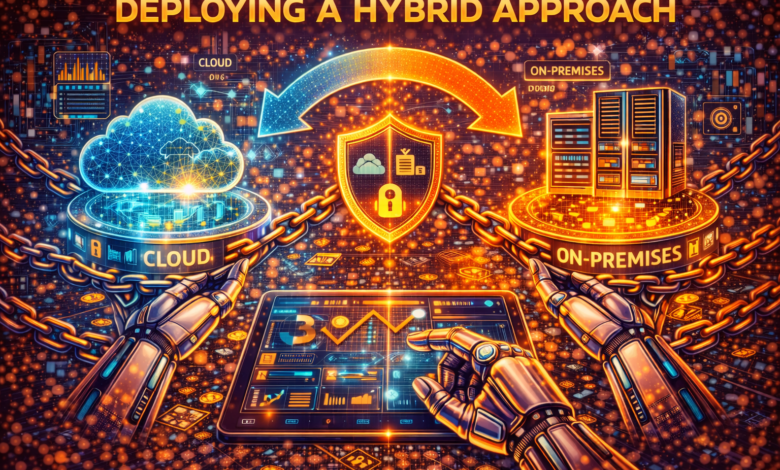
At the heart of hybrid Web3 lies infrastructure that seamlessly connects on-chain and off-chain components. Blockchain networks handle consensus, asset ownership, and governance, while off-chain systems manage storage, computation, and AI processing. This architecture reduces congestion and improves scalability without compromising security.
Cloud computing platforms play a crucial role in this setup by providing elastic resources for AI workloads. Data generated on-chain can be streamed to off-chain analytics engines, where AI models extract insights and feed them back into smart contracts. This feedback loop enables adaptive behavior within decentralized systems.
Deploying a hybrid approach to Web3 in the AI era also relies on oracles and middleware to bridge data between worlds. These components ensure that external data and AI-generated insights are securely and reliably integrated into blockchain environments. As hybrid infrastructure matures, it is becoming the backbone of scalable and intelligent Web3 ecosystems.
Security and Trust in Hybrid Web3 Models
Security is a cornerstone of Web3, and introducing hybrid elements raises important questions about trust. Centralized components can become points of failure if not designed carefully. However, hybrid architectures mitigate these risks by clearly defining trust boundaries and leveraging cryptographic guarantees.
In a well-designed hybrid system, critical operations remain decentralized and verifiable on-chain. AI models and off-chain processes can be audited using cryptographic proofs, ensuring that results are trustworthy. Techniques such as zero-knowledge proofs and secure multiparty computation enhance privacy and integrity within hybrid frameworks.
Deploying a hybrid approach to Web3 in the AI era requires a nuanced understanding of security trade-offs. By combining decentralized trust with enterprise-grade security practices, organizations can build resilient systems that inspire confidence among users and regulators alike.
Driving Hybrid Web3 Adoption
Hybrid Web3 architectures are already powering a wide range of real-world applications. In decentralized finance, AI-driven analytics improve liquidity management, fraud detection, and automated trading strategies. These capabilities would be impractical to run entirely on-chain, making a hybrid approach indispensable.
In digital identity, hybrid models enable secure, user-owned credentials combined with AI-based verification and fraud prevention. Users maintain control over their identities while benefiting from intelligent authentication systems. Similarly, in supply chain management, blockchain ensures transparency, while AI optimizes logistics and demand forecasting.
Deploying a hybrid approach to Web3 in the AI era is also transforming content creation and digital ownership. AI-generated content can be tokenized and governed by smart contracts, ensuring fair attribution and monetization. These use cases demonstrate how hybrid models unlock innovation across industries.
Challenges in Deploying a Hybrid Web3 Strategy
Despite its advantages, deploying a hybrid approach to Web3 in the AI era is not without challenges. Integrating decentralized and centralized systems requires careful architectural planning and interdisciplinary expertise. Misaligned incentives or poorly defined interfaces can undermine system integrity.
Data privacy is another critical concern. AI systems often rely on large datasets, raising questions about user consent and data ownership. Hybrid models must ensure that data usage aligns with Web3 principles of user sovereignty. Transparent governance frameworks and privacy-preserving technologies are essential to address these issues.
Additionally, maintaining interoperability between diverse platforms and protocols can be complex. As the Web3 ecosystem evolves, standards and best practices are still emerging. Overcoming these challenges requires collaboration, experimentation, and a commitment to open innovation.
Governance and Decentralization in Hybrid Models
Governance plays a vital role in maintaining the balance between decentralization and efficiency. Hybrid Web3 systems often employ decentralized governance mechanisms such as DAOs to oversee critical decisions. AI can support governance by analyzing proposals, forecasting outcomes, and detecting manipulation.
In the AI era, governance models must adapt to increasingly complex systems. Hybrid architectures enable flexible governance structures where decentralized communities set rules while AI assists with enforcement and optimization. This synergy enhances transparency and participation without overwhelming users.
Deploying a hybrid approach to Web3 in the AI era thus redefines governance as an intelligent, adaptive process. By blending human judgment, decentralized consensus, and AI insights, organizations can build systems that are both democratic and effective.
The Future of Hybrid Web3 in an AI-Driven World
Looking ahead, the convergence of Web3 and AI will continue to accelerate. As AI models become more efficient and blockchain technologies evolve, hybrid architectures will become more seamless and powerful. Innovations such as decentralized AI marketplaces and on-chain model verification are already emerging.
Deploying a hybrid approach to Web3 in the AI era positions organizations to adapt to this rapidly changing landscape. It enables them to experiment with new business models, enhance user experiences, and build trust in digital systems. The future internet will not be purely centralized or decentralized but intelligently hybrid.
This evolution represents a maturation of Web3 from an idealistic vision to a practical framework for global innovation. By embracing hybridity, developers and enterprises can unlock the full potential of decentralized intelligence.
Conclusion
Deploying a hybrid approach to Web3 in the AI era is a strategic response to the realities of modern technology. It acknowledges the strengths and limitations of both decentralization and artificial intelligence, creating systems that are secure, scalable, and intelligent. Rather than compromising Web3 principles, hybrid models enhance them by enabling real-world adoption and meaningful impact.
As AI continues to shape how data is processed and decisions are made, integrating it thoughtfully into Web3 architectures will be essential. Hybrid approaches offer a balanced pathway that aligns innovation with performance, compliance, and user experience. In doing so, they lay the foundation for a more resilient and intelligent digital future.
FAQs
Q. What does a hybrid approach to Web3 mean?
A hybrid approach to Web3 combines decentralized blockchain components with centralized or off-chain systems, enabling better scalability, performance, and AI integration.
Q. Why is AI important in Web3 systems?
AI enhances Web3 by enabling intelligent automation, data analysis, fraud detection, and personalized user experiences that are difficult to achieve with blockchain alone.
Q. Does a hybrid Web3 model compromise decentralization?
No, when designed correctly, hybrid models preserve decentralization for critical functions while using centralized systems for efficiency and AI processing.
Q. What industries benefit most from hybrid Web3 architectures?
Industries such as finance, digital identity, supply chain management, healthcare, and content creation benefit significantly from hybrid Web3 and AI integration.
Q. Is deploying a hybrid approach to Web3 future-proof?
Yes, hybrid architectures are adaptable and scalable, making them well-suited for evolving technologies and the long-term convergence of Web3 and AI.