

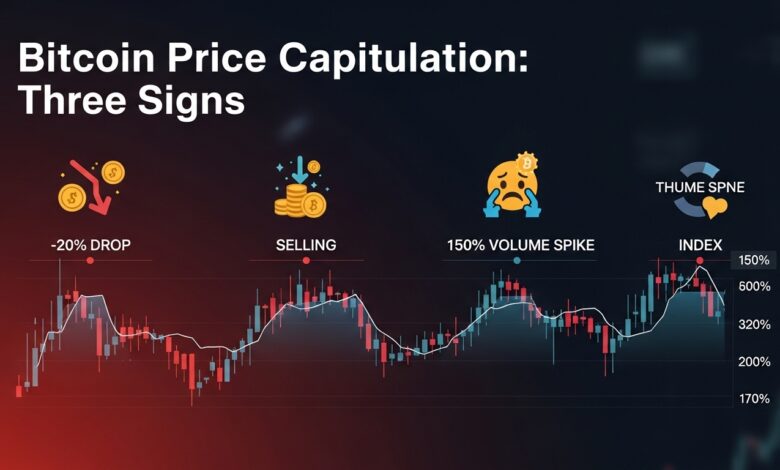
Bitcoin Price Capitulation Three Signs to Watch Now the cryptocurrency market is no stranger to volatility, and Bitcoin price movements often set the tone for the entire digital asset ecosystem. Periods of rapid growth are frequently followed by painful corrections, and these downturns tend to culminate in a moment many traders refer to as “full capitulation.” This phase represents the point where panic selling reaches its peak, weak hands exit the market, and long-term investors quietly begin to accumulate again.
Understanding whether the Bitcoin price is approaching full capitulation is critical for both short-term traders and long-term investors. Historically, major market bottoms have formed when sentiment reaches extreme pessimism, trading volumes spike during sell-offs, and technical indicators show deeply oversold conditions. These signals often appear together, creating a powerful combination that suggests a turning point may be near.
While no single indicator can perfectly predict the bottom, certain patterns have repeated throughout Bitcoin’s history. By studying these signals, investors can better prepare for potential opportunities and avoid emotional decision-making during market downturns. In this article, we will explore three key signs that suggest the Bitcoin price could be nearing full capitulation and what these indicators might mean for the broader cryptocurrency market, crypto investors, and the long-term outlook for digital assets.
Bitcoin Price Capitulation Three Signs
Before diving into the signs themselves, it is important to understand what “full capitulation” actually means in the context of Bitcoin price action.
What Is Capitulation?
Capitulation occurs when investors sell their assets in a state of panic, usually after a prolonged downtrend. This moment is characterized by intense fear, sharp price drops, and a surge in trading volume. During this phase, many market participants who bought at higher prices finally give up, locking in losses.
In the crypto market, capitulation is often more dramatic than in traditional financial markets because of the high volatility and emotional trading behavior. The Bitcoin price can experience rapid declines, triggering liquidations and cascading sell-offs.
Why Capitulation Matters
Capitulation is significant because it often marks the end of a bearish phase. When most sellers have exited the market, selling pressure decreases, allowing prices to stabilize and eventually recover. For experienced investors, this phase can represent an attractive entry point for long-term accumulation.
Sign One: Extreme Negative Market Sentiment
One of the clearest indicators that the Bitcoin price may be nearing full capitulation is overwhelmingly negative market sentiment.
Fear Reaching Historic Levels
During capitulation phases, the majority of investors expect prices to continue falling. Social media discussions, trading forums, and market commentary are often dominated by pessimistic predictions. Many traders who were previously bullish start to express doubt about the future of the cryptocurrency market.
Historically, some of the best buying opportunities have emerged when fear reached extreme levels. When the majority of participants are convinced that the Bitcoin price will fall further, it often signals that most sellers have already exited the market.
The Psychology Behind Market Bottoms
Market cycles are heavily influenced by investor psychology. At the peak of a bull run, optimism is widespread, and many investors expect prices to rise indefinitely. Conversely, during capitulation, despair and frustration take over.
This emotional shift often coincides with a sharp drop in trading activity among retail investors. Many leave the market entirely, believing that Bitcoin trading is no longer profitable. However, this is precisely the moment when long-term investors begin to accumulate digital assets quietly.
Sign Two: Sharp Price Drops Accompanied by High Volume
Another key signal of full capitulation is a sudden, aggressive decline in the Bitcoin price accompanied by unusually high trading volume.
The Importance of Volume Spikes
Trading volume plays a crucial role in confirming market trends. When the Bitcoin price drops sharply and volume increases significantly, it indicates that a large number of investors are selling at once.
This phenomenon is often referred to as a “capitulation event.” It reflects a final wave of panic selling, where traders rush to exit positions before prices fall further.
Liquidations and Forced Selling
In the crypto trading environment, leverage is common. Many traders borrow funds to increase their positions, hoping to amplify profits. However, when the Bitcoin price falls sharply, these leveraged positions can be liquidated automatically.
These liquidations create additional selling pressure, accelerating the downward movement. The result is a cascading effect where one liquidation triggers another, leading to a rapid drop in price.
While this process can be painful in the short term, it often helps cleanse the market of excessive leverage. Once the liquidations are complete, the Bitcoin market typically becomes more stable, setting the stage for a potential recovery.
Sign Three: Long-Term Holders Begin Accumulating
A third major sign that the Bitcoin price could be nearing full capitulation is increased accumulation by long-term holders.
The Role of Long-Term Investors
Long-term holders, often referred to as “strong hands,” are investors who hold their Bitcoin investment for extended periods, regardless of short-term price fluctuations. These participants tend to accumulate during periods of extreme fear and sell during times of euphoria.
When on-chain data shows that long-term holders are increasing their holdings, it suggests that experienced investors believe the Bitcoin price is undervalued.
Supply Shifts Toward Strong Hands
During capitulation phases, coins often move from short-term traders to long-term investors. This transfer of supply reduces the amount of Bitcoin available for immediate selling, which can eventually support price stability.
Historically, major market bottoms have coincided with significant accumulation by long-term holders. This pattern reflects a shift in market structure, where speculative traders exit and patient investors take their place.
Additional Indicators That Often Appear During Capitulation
While the three primary signs provide a strong framework, several additional indicators often accompany full capitulation in the Bitcoin price.
Deeply Oversold Technical Conditions
Technical indicators such as the Relative Strength Index often reach extremely low levels during capitulation. These readings suggest that the Bitcoin price has fallen too far, too quickly, and may be due for a rebound.
Oversold conditions do not guarantee an immediate recovery, but they frequently appear near market bottoms.
Declining On-Chain Activity
Another common sign is a drop in on-chain activity. Transaction volumes and active addresses may decrease as retail interest fades. This decline reflects reduced speculation and a quieter market environment.
While this may appear negative, it often indicates that the market is transitioning from a speculative phase to an accumulation phase.
How Capitulation Has Played Out in Past Bitcoin Cycles
Looking at historical Bitcoin price cycles provides valuable context for understanding capitulation events.
The 2018 Bear Market Bottom
After reaching an all-time high near $20,000 in 2017, the Bitcoin price entered a prolonged bear market. By late 2018, sentiment had turned extremely negative. Many investors believed the cryptocurrency experiment had failed.
In December 2018, the Bitcoin price dropped to around $3,000 amid heavy selling pressure. This event marked the capitulation phase, and the market gradually recovered in the following months.
The 2020 Pandemic Crash
In March 2020, global financial markets experienced a sharp downturn due to the pandemic. The Bitcoin price fell rapidly, dropping more than 40% in a single day.
This sudden crash triggered massive liquidations across the crypto market. However, it also marked a capitulation point. Within months, the Bitcoin price began a strong recovery, eventually reaching new all-time highs.
What Full Capitulation Could Mean for the Next Cycle
If the Bitcoin price is indeed nearing full capitulation, it could signal the beginning of a new accumulation phase.
Transition From Fear to Opportunity
Capitulation phases often represent the final stage of a bear market. Once selling pressure subsides, the market tends to move sideways for a period before entering a new uptrend.
For long-term investors, this phase can provide attractive entry points. Historically, buying during periods of extreme fear has produced strong returns over time.
The Importance of Patience
It is important to remember that markets rarely recover instantly after capitulation. Prices may remain volatile or trade sideways for weeks or months.
Investors who understand the cyclical nature of the Bitcoin price are better positioned to navigate these periods without making emotional decisions.
Conclusion
The Bitcoin price has always moved in cycles, alternating between periods of rapid growth and painful corrections. Full capitulation represents the final stage of a bearish phase, where panic selling reaches its peak and weak hands exit the market.
Three key signs often indicate that this moment may be near: extreme negative sentiment, sharp price drops accompanied by high trading volume, and accumulation by long-term holders. When these factors align, they can signal a potential market bottom.
While no indicator guarantees a reversal, understanding these patterns can help investors make more informed decisions. Historically, capitulation phases have preceded some of the most significant recoveries in the cryptocurrency market.
For those willing to remain patient and focus on long-term fundamentals, periods of fear may ultimately present valuable opportunities in the evolving world of digital assets.
FAQs
Q: What does full capitulation mean for the Bitcoin price?
Full capitulation refers to a point in the market where most investors sell their Bitcoin in panic after a prolonged downtrend. This phase is usually marked by sharp price declines, high trading volume, and extremely negative sentiment. It often signals that selling pressure is nearing exhaustion, which can eventually lead to price stabilization and the start of a new accumulation phase.
Q: How can investors recognize signs of Bitcoin capitulation?
Investors can look for several indicators, including extreme fear in market sentiment, sudden price drops with high trading volume, and increased accumulation by long-term holders. Technical signals such as oversold conditions and declining on-chain activity may also support the idea that the Bitcoin price is nearing a market bottom.
Q: Is capitulation a good time to buy Bitcoin?
Historically, capitulation phases have presented strong long-term buying opportunities. However, timing the exact bottom is extremely difficult. Investors often choose to accumulate gradually during periods of fear rather than attempting to buy at the precise lowest price. This strategy helps reduce the impact of short-term volatility.
Q: How long does it take for Bitcoin to recover after capitulation?
Recovery timelines vary depending on market conditions. In some cases, the Bitcoin price has begun rising within weeks of a capitulation event. In other cycles, it has taken several months of sideways movement before a new uptrend developed. Patience is essential during these periods.
Q: Can Bitcoin fall further even after signs of capitulation appear?
Yes, the Bitcoin price can still experience additional volatility even after capitulation signals emerge. Markets do not move in straight lines, and temporary rebounds or further declines are common. Capitulation indicators should be viewed as part of a broader analysis rather than as guarantees of an immediate reversal.