
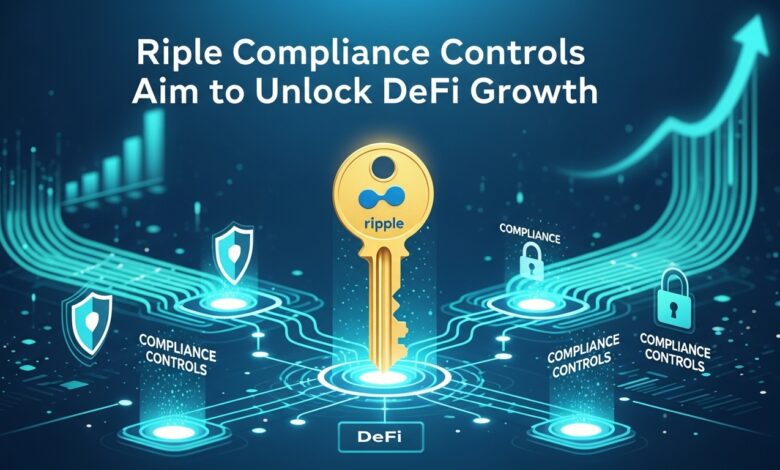
Ripple Compliance Controls Aim to Unlock DeFi Growth has long positioned itself as a bridge between traditional finance and the evolving world of digital assets. Over the years, the company has focused on building enterprise-grade solutions that emphasize speed, cost efficiency, and regulatory clarity. Recently, Ripple has argued that stronger compliance controls will unlock DeFi across its ecosystem, particularly on the XRP Ledger. The idea is simple in theory: if decentralized finance integrates institutional-grade safeguards, it could attract banks, payment providers, and regulated entities that have so far stayed on the sidelines.
However, despite these ambitions, one major obstacle continues to limit the impact of these plans. XRPL liquidity is still too thin to prove that compliance-driven DeFi can scale effectively. While the XRP Ledger offers technical advantages such as fast settlement times and low transaction costs, the depth of its liquidity pools and the size of its DeFi ecosystem remain relatively small compared to major networks.
The conversation around Ripple says compliance controls will unlock DeFi, but XRPL liquidity is still too thin to prove it has become a central debate in the industry. It highlights the tension between regulatory readiness and actual on-chain economic activity. This article explores the compliance-focused strategy, the state of liquidity on XRPL, and whether Ripple’s vision can realistically drive the next phase of decentralized finance adoption.
Ripple Compliance Controls Aim to Unlock DeFi Growth
Ripple’s strategy has increasingly centered on compliance, particularly as global regulators continue to scrutinize the crypto sector. Unlike many DeFi platforms that operate in loosely regulated environments, Ripple aims to create a system where institutions can interact with decentralized financial tools while still meeting regulatory requirements.
The company believes that compliance controls, regulated DeFi, and institutional adoption are interconnected. By introducing features that support identity verification, transaction monitoring, and regulatory reporting, Ripple hopes to make decentralized finance more appealing to banks and payment providers.
This approach reflects a broader trend across the crypto industry. As the market matures, the emphasis is shifting from purely permissionless systems to hybrid models that combine decentralization with regulatory oversight. Ripple’s thesis is that this balance will unlock large pools of institutional capital that have so far avoided DeFi due to compliance risks.
How Compliance Features Could Unlock New Capital
If compliance tools are implemented effectively, they could open the door to institutional liquidity, tokenized assets, and regulated financial products on the XRP Ledger. Banks and financial institutions typically require strict know-your-customer and anti-money laundering frameworks before participating in any financial system.
Ripple argues that by embedding these controls directly into the XRPL ecosystem, the network can support enterprise-grade DeFi applications. This could include tokenized bonds, cross-border settlement tools, and liquidity pools designed specifically for regulated participants.
In theory, this strategy would create a feedback loop. As more institutions join, liquidity would increase. As liquidity grows, the ecosystem becomes more attractive, drawing in additional participants and use cases.
Understanding XRPL Liquidity Challenges
What Liquidity Means in DeFi
Liquidity is the lifeblood of decentralized finance. It determines how easily assets can be traded, borrowed, or used as collateral. High liquidity leads to tighter spreads, lower slippage, and more efficient markets. Low liquidity, on the other hand, discourages participation and limits the usefulness of DeFi platforms.
When discussing the claim that Ripple says compliance controls will unlock DeFi, but XRPL liquidity is still too thin to prove it, liquidity becomes the key metric. Without sufficient depth in pools and trading pairs, even the most advanced compliance features cannot attract large-scale capital.
The Current State of XRPL DeFi Activity
Compared to leading DeFi ecosystems, the XRP Ledger still lags behind in total value locked, trading volume, and active protocols. Networks such as Ethereum, Solana, and other smart contract platforms have built extensive ecosystems filled with decentralized exchanges, lending protocols, and derivatives markets.
In contrast, XRPL’s DeFi landscape remains relatively small. While the ledger has strong capabilities for payments and asset transfers, its DeFi infrastructure, liquidity pools, and yield opportunities are still developing. This limited activity makes it difficult to demonstrate the effectiveness of compliance-driven DeFi models.
As a result, critics argue that Ripple’s compliance-first narrative is ahead of the actual market data. The ecosystem needs deeper liquidity before it can convincingly show that regulated DeFi is a viable alternative to existing platforms.
The Role of Institutions in XRPL’s Future
Why Institutions Care About Compliance
Financial institutions operate under strict regulatory frameworks. They must follow anti-money laundering rules, maintain audit trails, and ensure that transactions comply with local and international laws. This is why many banks have hesitated to engage with decentralized finance.
Ripple believes that integrating compliance-ready infrastructure, identity-based transactions, and regulated liquidity pools can solve this problem. If institutions feel confident that they can meet regulatory obligations, they may be more willing to deploy capital on-chain.
However, institutions also care deeply about liquidity. They need markets that can handle large transactions without causing price instability. If XRPL cannot provide sufficient liquidity, compliance alone may not be enough to attract major players.
The Chicken-and-Egg Problem
XRPL faces a classic liquidity dilemma. Institutions are unlikely to join without deep liquidity, but liquidity will not grow without institutional participation. This creates a cycle that is difficult to break. Ripple’s strategy assumes that compliance features will act as the catalyst. Once institutions see that the environment is safe and regulated, they may start participating, gradually increasing liquidity levels.
But until this happens, the claim that compliance controls will unlock DeFi remains largely theoretical. The ecosystem needs real-world examples of large-scale institutional activity to validate the model.
Comparing XRPL to Other DeFi Ecosystems
Ethereum and the Liquidity Advantage
Ethereum remains the dominant force in decentralized finance. Its ecosystem hosts thousands of protocols, with billions of dollars locked in liquidity pools. This depth allows traders and institutions to execute large transactions with minimal slippage.
Ethereum’s advantage lies in its network effects. Developers build on Ethereum because users and liquidity are already there. Users stay because the ecosystem offers diverse financial products. This creates a self-reinforcing cycle. XRPL, by contrast, is still in the early stages of building such an ecosystem. Even with compliance features, it must compete with networks that already have massive liquidity and active user bases.
Emerging Competitors in Regulated DeFi
Several newer blockchain networks are also exploring regulated DeFi, compliant tokenization, and institutional-grade protocols. Some are designed specifically for asset tokenization, while others focus on permissioned liquidity pools. This growing competition means XRPL cannot rely solely on compliance as a differentiator. It must also demonstrate strong liquidity, developer activity, and real-world use cases.
Technical Advantages of the XRP Ledger
Speed, Cost, and Efficiency
Despite liquidity concerns, the XRP Ledger offers several technical benefits. Transactions settle in seconds, and fees are typically a fraction of a cent. This makes XRPL particularly attractive for cross-border payments and high-frequency transactions.
These advantages could translate well into DeFi applications, especially those focused on microtransactions, real-time settlement, and low-cost trading. If liquidity improves, these features could become major selling points.
Built-In Features for Asset Issuance
XRPL has native support for issuing tokens, which simplifies the creation of stablecoins, tokenized securities, and other digital assets. This built-in functionality could make it easier for institutions to launch compliant financial products.
Combined with compliance controls, these features could position XRPL as a strong platform for regulated financial activity. However, without sufficient liquidity, the practical benefits remain limited.
The Importance of Developer and User Adoption
Building a Thriving DeFi Ecosystem
Liquidity does not appear automatically. It grows through user participation, developer innovation, and the creation of useful financial products. For XRPL to succeed, it needs a vibrant ecosystem of decentralized exchanges, lending platforms, and other DeFi tools.
Developers play a crucial role in this process. They create the applications that attract users and liquidity. Without a strong developer community, even the most advanced blockchain technology can struggle to gain traction.
Incentives and Ecosystem Growth
Many successful DeFi ecosystems have used incentives such as liquidity mining, staking rewards, and developer grants to attract participants. XRPL may need similar strategies to accelerate adoption.
If Ripple can combine compliance features with strong incentives, it may be able to overcome the current liquidity gap. This would help transform the narrative from theoretical potential to measurable results.
Can Compliance Alone Unlock DeFi?
The Limits of Regulatory Readiness
Compliance is undoubtedly important, especially for institutional adoption. However, it is not the only factor that determines the success of a DeFi ecosystem. Liquidity, user experience, developer activity, and network effects all play significant roles. The claim that Ripple says compliance controls will unlock DeFi, but XRPL liquidity is still too thin to prove it reflects this reality. Compliance may open the door, but liquidity is what keeps participants inside.
A Balanced Path Forward
For XRPL to realize its full potential, it will likely need a balanced approach. Compliance features can attract institutions, while incentives and developer support can build the liquidity needed to sustain growth.
If these elements come together, XRPL could carve out a unique position as a regulated, institution-friendly DeFi platform. Until then, the ecosystem remains in a transitional phase.
Conclusion
Ripple’s vision of compliance-driven decentralized finance is ambitious and potentially transformative. By integrating regulatory safeguards into the XRP Ledger, the company aims to create an environment where institutions can participate confidently in DeFi.
However, the success of this strategy ultimately depends on liquidity. Without deep and active markets, compliance features alone cannot drive large-scale adoption. The current state of XRPL liquidity suggests that the ecosystem still has significant work to do before it can validate Ripple’s claims.
The debate around Ripple says compliance controls will unlock DeFi, but XRPL liquidity is still too thin to prove it highlights a broader challenge in the crypto industry. Bridging the gap between regulatory readiness and real economic activity is no small task. If Ripple can solve the liquidity problem while maintaining its compliance focus, XRPL could become a major player in the next phase of decentralized finance.
FAQs
Q: Why does Ripple believe compliance controls will unlock DeFi?
Ripple believes that many institutions have avoided decentralized finance because of regulatory uncertainty. By introducing compliance controls such as identity verification and transaction monitoring, the company aims to create an environment where banks and financial firms can participate without violating regulations. This could bring large amounts of institutional capital into the DeFi ecosystem, increasing liquidity and adoption.
Q: What does it mean that XRPL liquidity is still too thin?
When analysts say XRPL liquidity is too thin, they are referring to the relatively small size of its DeFi markets compared to major networks. Lower total value locked, fewer trading pairs, and limited activity in lending or derivatives platforms make it harder to support large transactions. This lack of depth can discourage institutional participants who require stable and liquid markets.
Q: How does XRPL compare to other DeFi networks?
XRPL offers fast transaction speeds and low fees, which are significant technical advantages. However, it currently trails networks like Ethereum in terms of total value locked, number of protocols, and overall ecosystem activity. This difference in scale is one of the main reasons critics question whether compliance alone can drive XRPL’s DeFi growth.
Q: Can institutional adoption solve XRPL’s liquidity problem?
Institutional adoption could significantly increase liquidity if major banks, payment providers, or asset managers begin using XRPL-based DeFi platforms. Large capital inflows would deepen liquidity pools and attract additional users. However, institutions typically require strong liquidity before entering a market, which creates a cycle that is difficult to break without targeted incentives or early adopters.
Q: What needs to happen for XRPL DeFi to grow?
For XRPL DeFi to expand, the ecosystem will likely need a combination of factors. These include stronger developer activity, more decentralized applications, incentive programs to attract liquidity, and successful institutional use cases. If compliance features are paired with real economic activity, XRPL could become a competitive platform in the regulated DeFi space.