
Senate Crypto Legislation Stalls as DeFi Oversight Fight Grows
Senate crypto legislation stalls as DeFi oversight divides lawmakers, raising questions over risks, innovation, and the future of U.S. digital asset regulation.


The United States is closer than ever to a comprehensive framework for crypto regulation, yet the most important pieces of the puzzle remain unfinished. While the Senate has already advanced a major bill on stablecoin regulation, broader Senate crypto legislation covering trading, exchanges, and decentralized finance (DeFi) has stalled. The core problem is no longer whether to regulate crypto—but how far to go, and who should be responsible for overseeing rapidly evolving digital asset markets.On one side, a coalition of senators argues that DeFi oversight must be tough, with strong rules to combat money laundering, terrorism financing, and sanctions evasion. They point to warnings from national security experts who say poorly designed digital asset legislation could open loopholes big enough for hostile regimes and criminal networks to exploit.On the other side, pro-innovation lawmakers and industry advocates warn that overly aggressive rules could crush startups, push activity offshore, and undermine America’s chance to lead in Web3 and blockchain innovation.
Recent months have made the split obvious. Senate Democrats floated proposals to crack down on DeFi frontends and empower the Treasury to blacklist risky platforms, drawing fierce backlash from crypto firms and even some traditionally pro-crypto Democrats.At the same time, bipartisan talks over a sweeping crypto market structure bill have repeatedly missed informal deadlines as negotiators argue over DeFi, enforcement tools, and the roles of the SEC and CFTC.The result is a legislative paradox: Congress is passing narrow, targeted crypto laws while the bigger debate over DeFi regulation and market structure keeps grinding to a halt. For investors, builders, and everyday users, this gridlock is more than political drama—it shapes the future of how crypto can be used, traded, and built in the U.S.
How the Senate’s Crypto Fight Reached This Point
why to the Senate crypto legislation is stuck, it helps to look at the path that led here.Early attempts at comprehensive digital asset regulation, like the Lummis-Gillibrand Responsible Financial Innovation Act (RFIA), aimed to answer big structural questions: which agency should regulate which types of tokens, how to treat ancillary assets, how to tax digital assets and DAOs, and what disclosures should be required from issuers and service providers.These efforts were ambitious but faced heavy political headwinds, including skepticism from regulators and concerns about consumer protection.
Meanwhile, the House moved its own Digital Asset Market Structure bill (often described through the CLARITY Act and related proposals), focusing on dividing jurisdiction between the SEC and CFTC and creating clearer categories like “digital commodities.The Senate Banking and Agriculture Committees worked on parallel drafts, reflecting the split between securities and commodities oversight.By 2025, momentum shifted. A high-profile stablecoin bill—the GENIUS Act—cleared the Senate with a strong bipartisan vote, creating a federal regime for payment stablecoins, reserve requirements, and disclosures.The House followed with its own stablecoin legislation and additional bills on market structure and a CBDC ban, sending a package toward the White House.Yet even as stablecoins made progress, the broader crypto market structure and DeFi oversight pieces bogged down. Competing drafts from Banking and Agriculture still need to be reconciled, and partisan tensions over a new Democratic DeFi proposal have effectively pushed the Senate’s comprehensive framework into a holding pattern.
Why Senate Crypto Legislation Is Stuck Today
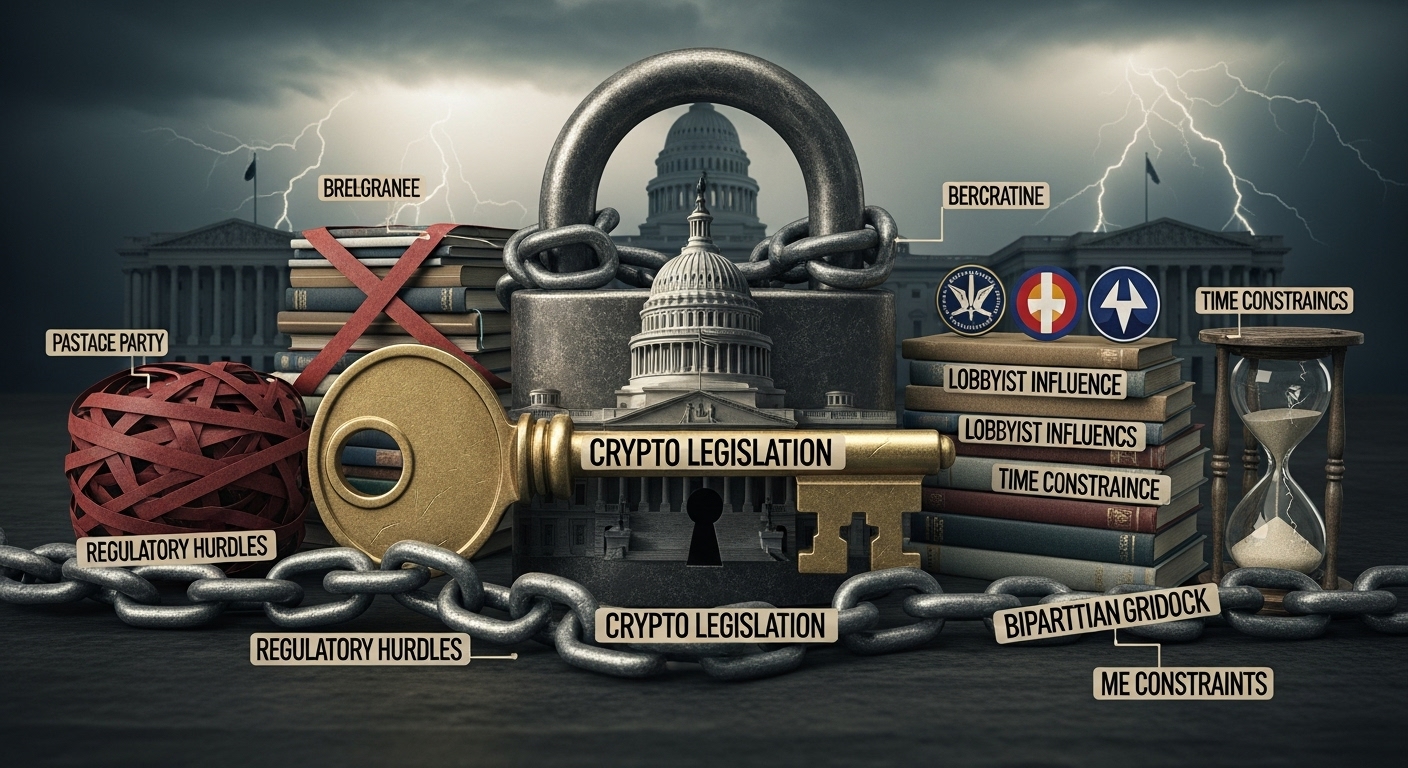
The stall is not about whether to regulate; it’s about how, who, and how hard. Three fault lines, in particular, explain why Senate crypto legislation stalls amid disagreements on DeFi oversight.
Jurisdiction Battles SEC vs. CFTC and Committee Turf
One of the most stubborn disputes is jurisdiction. Crypto doesn’t fit neatly into traditional categories, so lawmakers must decide when a token is a security, when it is a commodity, and when it’s something else entirely.The Senate Banking Committee tends to align more closely with the SEC’s investor-protection focus and securities law framework. The Agriculture Committee leans into CFTC oversight and commodities law, particularly for spot markets and derivatives. Their respective drafts differ on how to define digital assets, how to treat tokens sold in investment contracts, and what level of disclosures are required.These differences are not just technical—they determine which committee has more power, which regulator sets the rules, and how much room the crypto industry has to interpret those rules. Until these jurisdictional battles are resolved, a unified crypto market structure bill remains elusive.
Partisan Divide on Consumer Protection and National Security
Crypto policy has become a proxy fight for deeper disagreements over financial risk and national security. Progressive Democrats, led by figures like Senator Elizabeth Warren, argue that crypto is riddled with scams, speculation, and opportunities for illicit finance and that any digital asset legislation must put strong anti-money-laundering (AML) and sanctions rules front and center.Security experts have echoed these concerns, warning that some proposed market-structure bills—such as the CLARITY Act and RFIA—could create loopholes for money launderers, kleptocrats, and sanctioned entities if DeFi and crypto mixers are not tightly regulated.More market-friendly Republicans and centrist Democrats, however, see an opportunity for the U.S. to reclaim leadership in Senate crypto legislation , especially after years of regulation-by-enforcement. They worry that framing crypto primarily as a national security threat could lead to overly broad surveillance, harsh penalties for non-custodial services, and a chilling effect on open-source development.The result is a stalemate: both sides insist on “responsible” crypto regulation in the US, but they disagree on what that means in practice.
What Makes DeFi Oversight So Controversial?
DeFi oversight is the flashpoint because DeFi doesn’t look like traditional finance at all. Instead of banks and broker-dealers, DeFi relies on smart contracts, autonomous protocols, and governance tokens. That raises hardRecent Democratic proposals suggest treating key DeFi access points, like websites and UI providers, as regulated entities, granting Treasury authority to blacklist risky platforms and compel tighter compliance. Industry groups argue that this approach could effectively criminalize open-source tooling and push core innovation offshore, even as risky platforms continue operating from more permissive jurisdictions.Until lawmakers develop a model of DeFi regulation that both reduces risk and respects the technology’s decentralized nature, comprehensive Senate crypto legislation is likely to keep stalling.
Stablecoins The Piece That Moved While DeFi Stuck
Curiously, stablecoin oversight is where Congress has made the biggest progress, even while DeFi oversight remains unsettled.
The GENIUS Act as a Template
The Senate-passed GENIUS Act creates a federal regime for payment stablecoins pegged to the U.S. dollar, requiring issuers to hold safe, liquid reserves and disclose them regularly. The bill also introduces guardrails on who can issue stablecoins and how they interact with the broader financial system.This legislation shows that lawmakers can reach bipartisan agreement when the use case is clearly tied to payments, consumer protection, and financial stability. Stablecoins look enough like bank deposits and money-market funds that existing regulatory concepts can be adapted.
Market Structure and DeFi: The Missing Links
But stablecoins alone do not solve the bigger issues. They are just one building block in a much larger crypto market structure ecosystem that includes exchanges, lending platforms, derivatives, DAOs, and DeFi protocols.Without a unified approach to these issues, even a strong stablecoin regulation framework leaves major gaps in crypto market structure and DeFi risk management.
The Risks Lawmakers See in DeFi
To why DeFi oversight is so contentious, it’s helpful to examine the risks senators keep returning to in hearings and letters.
Illicit Finance and Sanctions Evasion
DeFi protocols can be used 24/7, across borders, without permission. That’s a feature for users—but a red flag for law enforcement. Advocacy groups and security researchers warn that some proposed bills do not give the Treasury and regulators enough power to monitor or restrict DeFi-based money laundering and sanctions evasion.High-profile cases involving crypto mixers and sanctioned addresses have intensified demands for strong AML and KYC rules, even in decentralized environments. Lawmakers pushing for stricter DeFi regulation argue that national security must come before pure decentralization.
Systemic Risk, Runs, and Investor Losses
Even without criminal activity, DeFi has experienced spectacular failures. Algorithmic stablecoin collapses, protocol hacks, and liquidity runs can wipe out billions of dollars’ worth of user funds and send shockwaves through the broader crypto industry.Critics worry that, as DeFi grows larger and more interconnected with traditional finance, these events could become systemic. They argue that digital asset legislation should introduce capital requirements, stress testing, and disclosure rules similar to those applied to banks and large financial institutions.Supporters of DeFi respond that over-regulation could stifle the very innovation that might make financial markets more open and efficient.
Smart Contract Bugs and Governance Failures
Another challenge is technical. DeFi relies heavily on smart contracts and on-chain governance. Bugs in smart contracts, oracle failures, and rushed governance votes can create vulnerabilities that attackers exploit.Some lawmakers want rules that explicitly assign liability—even in decentralized settings—for inadequate audits, poor disclosures, or reckless governance. Senate crypto legislation Others are wary of turning every bug into a regulatory violation, arguing that DeFi risks should be addressed through better coding standards, insurance pools, and market discipline rather than heavy-handed enforcement.
What Stalled Legislation Means for the Crypto Industry

When Senate crypto legislation stalls amid disagreements on DeFi oversight, the consequences ripple far beyond Washington.First, regulatory uncertainty remains high. Exchanges, custodians, and DeFi teams are left guessing how future crypto market structure regulation will categorize their products, what licenses they will need, and which regulators they will answer to. For larger institutions, this uncertainty can be a reason to delay or limit participation in crypto markets.Second, the U.S. risks falling behind global competitors. Regions like the European Union have already adopted comprehensive frameworks such as MiCA, providing clearer expectations for issuers and service providers. While no regime is perfect, clarity itself can be a competitive advantage for attracting capital and talent.
Third, enforcement fills the vacuum. In the absence of detailed digital asset legislation, agencies rely on existing laws and case-by-case enforcement. That leads to accusations of “regulation by lawsuit,” a patchwork of interpretations, and costly legal battles. Many industry players argue that a clear, unified statute from Congress would be better—for both innovation and investor protection—than an endless series of ad-hoc enforcement actions.Finally, retail users are left without consistent protections. Some crypto platforms operate under bank-like or broker-dealer regimes; others live in gray zones. Without a comprehensive framework, it is harder to ensure that disclosures, custody standards, and risk warnings are consistent across the ecosystem.
Possible Paths Forward for Senate Crypto Legislation
Even with talks stalled, there are several realistic ways the Senate could eventually break the deadlock.
Narrow, Risk-Focused DeFi Rules
One option is to narrow the immediate scope of DeFi oversight to clear, high-risk areas: mixers, privacy tools specifically designed to obfuscate flows, and large protocols handling systemically significant volumes of stablecoins and other liquid tokens.A targeted approach could give the Treasury and regulators the tools they need to address the highest illicit finance risks while leaving space for lower-risk experimentation. Over time, Congress could expand or refine the framework as they learn more about how DeFi evolves.
Phased or Pilot Regulatory Sandboxes
Another path is a phased rollout or sandbox model. Instead of trying to solve every crypto market structure issue at once, Congress could authorize pilots in which certain DeFi or digital asset activities are subject to tailored rules, enhanced reporting, and close supervision.If these pilots prove that safeguards can work without crushing innovation, they might build trust between skeptical lawmakers and the crypto ecosystem, making a broader deal easier.
Global Coordination and International Standards
Because DeFi is inherently cross-border, unilateral U.S. rules will always have limits. Some senators and policy experts have argued for greater coordination with allies through bodies like the Financial Action Task Force (FATF) and IOSCO. Global standards on DeFi regulation, AML controls, and stablecoin oversight could help build a consistent baseline, even if each jurisdiction implements them differently.If the U.S. plays a leading role in drafting these standards, it can shape rules that protect its interests without yielding the field to other major economies.
What Investors and Builders Should Watch
Even with no final bill yet, there are clear signals that investors, developers, and businesses can track to where Senate crypto legislation is heading.Watch the committees. The Senate Banking and Agriculture Committees remain the hubs for digital asset legislation. Draft updates, staff discussion papers, and hearings all provide clues about what language might eventually make it into a final package Follow DeFi-specific proposals. When senators float new ideas for regulating DeFi frontends, on-chain governance, or AML requirements for non-custodial services, those proposals often test the boundaries of what is politically feasible.Track the White House and regulators. Even as Congress debates, agencies like the SEC, CFTC, and Treasury are constantly updating guidance, enforcement priorities, and interpretations. These moves can effectively shape crypto regulation in the US long before any bill is signed.Most importantly, pay attention to where bipartisan agreement emerges. Stablecoin legislation showed that when both parties see clear consumer benefits and manageable risks, progress is possible. Something similar could eventually happen around crypto market structure and even DeFi oversight, but only if lawmakers converge on a shared definition of “responsible innovation.”
Conclusion
The United States is in a transitional moment. A major stablecoin regulation bill has already cleared Congress, but broader Senate crypto legislation stalls amid disagreements on DeFi oversight as lawmakers remain split on potential risks. The core issues—jurisdiction, national security, investor protection, and the nature of decentralization—are not easy to resolve.Yet the direction of travel is clear: crypto will not remain in a regulatory vacuum. Whether through comprehensive statutes, targeted measures, or continued enforcement, a framework is coming. The open question is whether that framework will balance innovation and safety or tilt decisively toward one side.For now, builders, investors, and users must navigate an environment where pockets of clarity (like stablecoins) exist alongside foggy zones (like DeFi and market structure). The best strategy is to stay informed, adopt robust crypto compliance practices, and design products that can adapt to evolving rules.If Congress can eventually translate its debates into balanced digital asset legislation, the U.S. might still secure a leading role in the next era of finance. But until senators find common ground on DeFi regulation and risk, the future of America’s crypto policy will remain, quite literally, stuck in committee.
FAQs
Q: Why is Senate crypto legislation taking so long to pass?
Senate crypto legislation is slow because lawmakers are trying to solve several hard problems at once: how to divide authority between the SEC and CFTC, how to regulate decentralized finance (DeFi) without killing innovation, and how to address national security and consumer-protection concerns. Different committees and parties have competing priorities, and comprehensive bills must reconcile all of them before reaching the Senate floor.
Q: How does DeFi oversight differ from traditional financial regulation?
In traditional finance, regulators oversee identifiable intermediaries such as banks, brokers, and payment companies. DeFi relies on smart contracts and protocols that can run without a central operator. That makes it harder to assign responsibility for AML, KYC, and investor protection. Some proposals focus on regulating DeFi frontends and key infrastructure, while others emphasize code audits, disclosures, and risk management rather than bank-style licensing.
Q: What has actually passed so far in U.S. crypto regulation?
The most significant federal breakthrough so far is the Senate-passed GENIUS Act, a comprehensive stablecoin regulation bill that sets reserve, disclosure, and licensing standards for dollar-pegged tokens. The House has also advanced bills on market structure and a ban on a Federal Reserve–issued CBDC, though the broader market-structure and DeFi framework is still unfinished.
Q: What are the main risks of DeFi that concern lawmakers?
Lawmakers worry about three big categories of DeFi risks: illicit finance and sanctions evasion via permissionless protocols and mixers; systemic risk from protocol failures, liquidity runs, and interconnected stablecoin markets; and technical vulnerabilities such as smart contract bugs and governance failures. National security experts have warned that weak DeFi rules in major bills could create loopholes for corrupt regimes and criminal networks.
Q: How should crypto projects prepare while the Senate is still debating?
Projects should not assume the status quo will last. Instead, they can prepare by implementing strong compliance controls, being transparent with users about risks, and designing products that can be adapted to different regulatory outcomes. Watching developments in crypto market structure drafts, DeFi-specific proposals, and stablecoin rules can help teams anticipate what future digital asset legislation may require and avoid costly redesigns later