Bitcoin Price Jumps Near $94,000 After Sub-$90K Dip
Bitcoin price rebounds toward $94,000 after a sharp sub-$90K drop. Learn what’s driving the rally, key levels, and what it could mean for traders next.


Bitcoin Price Jumps in the Bitcoin price is a textbook example of how this asset tends to behave during strong bull cycles. Volatility expands, pullbacks deepen, and yet, aggressive buying continues to emerge on every major dip.
The Sub-$90,000 Shakeout
Bitcoin Price Jumps below $90,000 was triggered by a combination of factors. During mature phases of a crypto bull market, leveraged positioning often becomes stretched. Even a modest negative catalyst—such as a cautious macro headline, a short-term uptick in bond yields, or profit-taking after a strong run—can spark a cascade of liquidations.
When Bitcoin Price Jumps slipped beneath $90,000, a wave of long liquidations hit derivative exchanges, amplifying the sell-off. This type of market volatility is not unusual; historically, Bitcoin has seen intra-cycle corrections of 20%–30% or more, even while maintaining a broader bullish structure.
Under the surface, on-chain metrics suggested that large holders and institutional investors were not capitulating en masse. Instead, there were early signs that long-term holders, or “HODLers,” were largely sitting tight, while short-term speculators absorbed most of the damage. This is characteristic of shakeouts that flush out leverage without fundamentally breaking the trend.
Rapid Recovery Toward $94,000
Following the shakeout, dip-buyers quickly stepped in. As spot demand returned and liquidations slowed, the Bitcoin price began to reclaim key levels, first $90,000, then $92,000, and finally pushing toward $94,000. The intraday high around $93,700 highlights how aggressive the rebound has been, suggesting that a lot of sidelined capital was waiting for “a better entry” after the previous all-time highs.
This kind of V-shaped recovery often indicates that the market still perceives Bitcoin as being in a structurally bullish trend. In a genuine bear market reversal, bounces tend to be weaker, shorter, and quickly sold into. In contrast, this latest move has been backed by strong spot volume, ETF inflows, and renewed social interest.
The Bigger Picture: Bitcoin In A Post-Halving, ETF-Driven Cycle
To understand the current Bitcoin price near $94,000, it is crucial to zoom out and see where we are in the larger cycle.
The Impact Of The 2024 Bitcoin Halving
The fourth Bitcoin halving occurred in April 2024, cutting the block reward from 6.25 BTC to 3.125 BTC. This event effectively slows the rate of new Bitcoin entering circulation, reinforcing its narrative as digital gold with a capped supply of 21 million coins.
Historically, halving events have not always produced an immediate price spike on the exact day, but they have consistently influenced multi-year cycles. Price rallies have often accelerated in the months following halvings, as the combination of reduced supply and growing demand from spot Bitcoin ETF products and retail investors creates a favorable environment for higher prices.
In the current cycle, BTC already reached a series of new all-time highs—first in the $70,000s in early 2024, then above $100,000, and eventually beyond $120,000 in mid-2025. The latest move toward $94,000 comes after one of several large corrections within this broader uptrend, fitting well with historical post-halving behavior.
Spot Bitcoin ETFs And Institutional Demand
One of the most important drivers of this cycle has been the approval and growth of spot Bitcoin ETFs in major markets. Regulators in the United States approved the first wave of spot Bitcoin ETFs in early 2024, leading to significant inflows from both retail and institutional investors.
These products make it far easier for traditional portfolios to gain exposure to Bitcoin without having to manage private keys, exchanges, or direct custody. As a result, ETF holdings have become a major component of overall BTC demand. During bullish phases, strong ETF inflows can act as a persistent buy-side force, helping support price and shortening the duration of pullbacks.
Even during the recent sub-$90K dip, ETF data and fund flows suggested that larger players were not abandoning Bitcoin. Instead, there was evidence that some institutions used the drop as a chance to rebalance or increase exposure at lower prices, reinforcing the view that the long-term Bitcoin price outlook remains constructive.
Key Technical Levels Around The $94,000 Zone
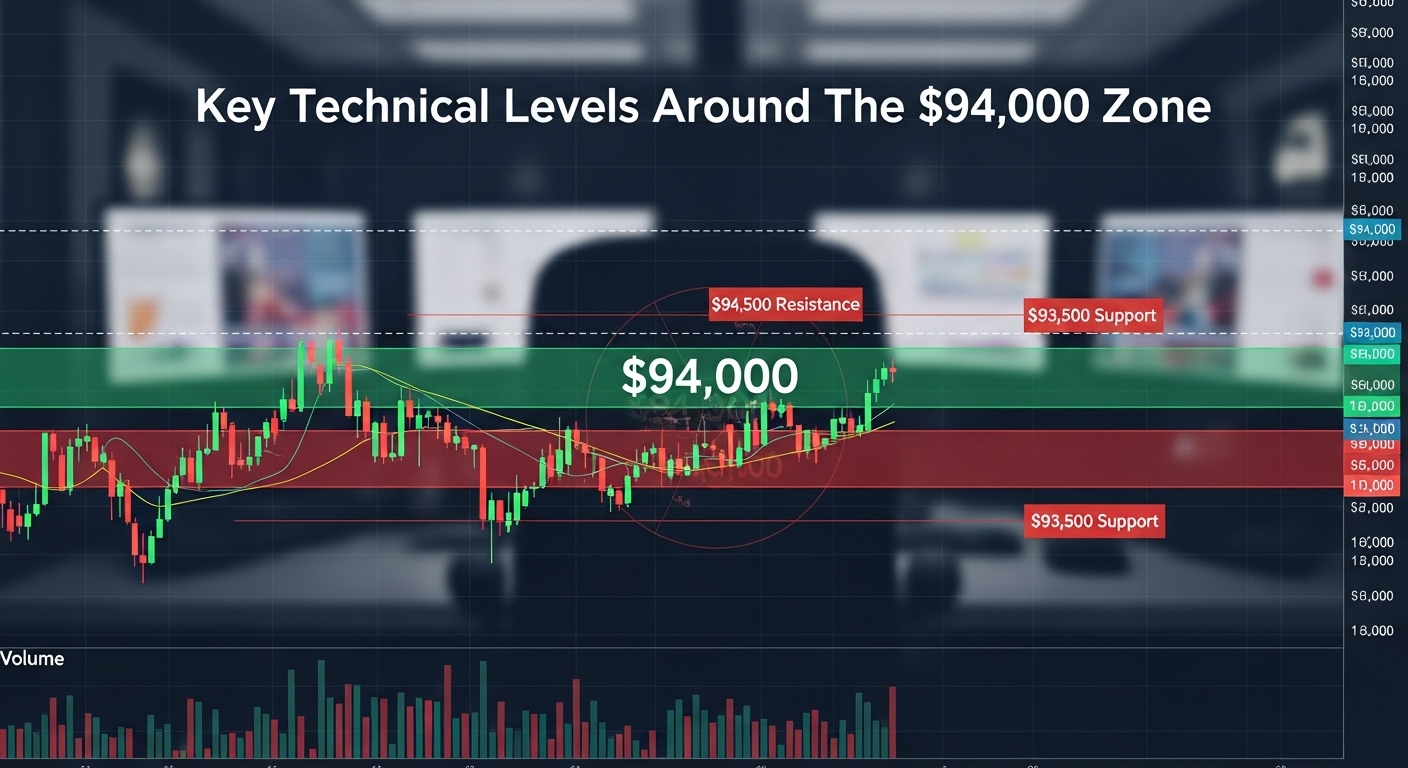
While fundamentals and narratives matter, many traders make decisions based on technical levels. The region between $90,000 and $94,000 has become a crucial battleground in the short to medium term.
Support Around $88,000–$90,000
The area just below and above $90,000 now represents an important support zone. It is where the recent shakeout bottomed and where strong buyer interest emerged. If the Bitcoin price revisits this zone, traders will closely watch whether buyers defend it again.
A sustained break and close well below this area, especially with rising volume, could signal a deeper correction toward previous consolidation regions. Depending on the broader trend, that might open the door to tests of lower support levels that were built earlier in the cycle. For the moment, however, the market has treated sub-$90K prices as an opportunity rather than a danger zone.
Resistance Near $94,000–$98,000
On the upside, the immediate resistance sits just below and around $94,000. A strong daily close above this level, accompanied by healthy volume and continued ETF inflows, would be a positive sign for bulls.
Beyond $94,000, there are intermediate resistance zones between $98,000 and the six-figure region. Psychologically, $100,000 Bitcoin remains a major milestone. Markets often behave erratically around such round numbers, with fake breakouts, sudden wicks, and sharp intraday reversals. Traders will be monitoring this area for signs of either exhaustion or renewed momentum.
As BTC moves between these levels, the Bitcoin price chart is forming the kind of back-and-forth consolidation that often precedes a bigger move. Whether that next major move is up or down will depend on how broader conditions evolve in the coming weeks.
Fundamental Drivers: Why Bitcoin Remains In Demand
The current rebound in Bitcoin price is not happening in a vacuum. Several fundamental factors continue to underpin demand for BTC, even as short-term volatility remains high.
Macroeconomic Backdrop And “Digital Gold” Narrative
In recent years, Bitcoin has increasingly been compared to gold as a form of store of value. Concerns about inflation, central bank policy, and long-term debt sustainability have pushed more investors to consider Bitcoin as a hedge or diversifier within their portfolios.
In this environment, macro headlines play a significant role. Expectations around interest rate cuts, shifts in risk appetite, and geopolitical uncertainty can all influence the cryptocurrency market. When risk assets broadly catch a bid, Bitcoin often leads, benefiting from its first-mover advantage and growing institutional acceptance.
The narrative of Bitcoin as digital gold has also been strengthened by its predictable monetary policy. With each halving, the rate of new supply falls, making BTC scarcer over time—especially when compared with fiat currencies, whose supply can expand significantly in response to economic stress.
On-Chain Data: Long-Term Holders VS Short-Term Speculators
On-chain data offers valuable insights into who is actually buying and selling. During the recent dip, several on-chain metrics suggested that long-term holders, who have held BTC for months or years, were not selling aggressively. Instead, short-term holders and leveraged traders accounted for most of the realized losses.
This pattern aligns with previous bull cycles, where weak hands tend to sell into fear and volatility, while strong hands accumulate more coins at discounted prices. Metrics like the proportion of BTC held for more than one year, or the spending behavior of older coins, support the view that core conviction among long-term believers remains intact.
As long as long-term holders keep their coins off exchanges and supply remains constrained, relatively modest increases in demand can have an outsized impact on the Bitcoin price, particularly around key psychological thresholds like $90,000 and $100,000.
Bitcoin Price Outlook: Can BTC Extend The Rally Beyond $94,000?
No one can predict the future with certainty, but by combining technical analysis, fundamentals, and historical patterns, traders can build informed scenarios for the Bitcoin price.
Bullish Scenario: Retest Of All-Time Highs
In a bullish scenario, the recent sub-$90K dip is remembered as another deep but ultimately healthy correction within a crypto bull run. Inflows into spot Bitcoin ETFs remain strong or begin to accelerate again, macro conditions stay supportive, and risk appetite continues to improve.
Under these conditions, a decisive breakout above $94,000, followed by a strong push through $100,000, could set the stage for another leg higher. With Bitcoin’s previous all-time high already above $120,000, a retest or even a fresh extension of that high would not be surprising for seasoned crypto observers.
In such a case, BTC price prediction models that take into account halving cycles, stock-to-flow dynamics, and adoption trends might again draw attention, especially those suggesting that Bitcoin could move significantly beyond its prior peak if current cycle conditions remain intact.
Bearish Scenario: Deeper Correction Before The Next Leg
In a more cautious or bearish scenario, the recovery toward $94,000 fails to gain strong follow-through. ETF flows slow or temporarily reverse, macro data disappoints, or regulatory headlines weigh on sentiment. In this environment, the Bitcoin price could slip back toward support near $90,000 and possibly break below it.
A deeper correction toward previously consolidated areas would not necessarily invalidate the long-term bullish thesis, but it could extend the duration and depth of the current drawdown. Historically, even during strong cycles, Bitcoin has experienced multiple sharp corrections before resuming its uptrend.
Traders focused on risk management will pay close attention to how BTC behaves around major support zones, while long-term investors may view such drawdowns as opportunities to gradually increase exposure, rather than trying to time the exact bottom.
Risk Management: Navigating Bitcoin’s Volatility

While a Bitcoin price near $94,000 might feel exciting, volatility cuts both ways. Deep pullbacks, rapid liquidations, and emotional decision-making can all hurt results, especially for newer traders.
Leverage And Liquidations
Crypto derivatives platforms offer high leverage, sometimes far beyond what is prudent for most participants. During sharp moves like the recent sub-$90K dip, excessive leverage can cause cascading liquidations that exacerbate price swings.
Prudent traders often prefer lower leverage or spot exposure, particularly when Bitcoin is already trading near historically elevated levels. Managing position size, using stop-losses, and avoiding over-concentration in a single asset are critical aspects of risk control in a market as fast-moving as crypto.
Time Horizons And Investment Goals
Another key element of navigating Bitcoin’s volatility is aligning your strategy with your time horizon. Short-term traders may focus on intraday or swing setups, support and resistance, and funding rates, while long-term holders care more about multi-year adoption trends, halving cycles, and macro narratives.
Regardless of the approach, it is vital to have a clear plan. The emotional intensity of rapid moves—from sub-$90K fear to $94,000 euphoria in a short span—can easily lead to impulsive decisions. A written strategy and disciplined execution can help investors avoid chasing FOMO at the top or panic-selling at the bottom.
Above all, remember that cryptocurrencies are high-risk assets. No outcome is guaranteed, and no single model or narrative can fully capture the complexity of the market.
Conclusion
The recent move in the Bitcoin price, rebounding from a sub-$90,000 dip to trade near $94,000, is a powerful reminder of how quickly sentiment can shift in the cryptocurrency market. What looked briefly like the start of a deeper correction has, at least for now, turned into another aggressive buy-the-dip episode.
Behind the charts, several forces are at play: the post-halving supply squeeze, continued interest from institutional investors, the growth of spot Bitcoin ETFs, and a macro backdrop that keeps the idea of Bitcoin as digital gold firmly in the spotlight. At the same time, on-chain data indicates that long-term holders remain largely committed, while leverage and short-term speculation continue to drive the most dramatic spikes in volatility.
Whether BTC breaks convincingly above $94,000 and marches toward six-figure territory, or revisits support below $90,000 first, will depend on the interplay of these factors in the weeks ahead. For traders and investors alike, the key is to stay informed, manage risk, and recognize that such price swings are part of the DNA of Bitcoin. Nothing in this article is financial or investment advice. Always do your own research and consider consulting a qualified professional before making investment decisions.
FAQs
Q: Why did the Bitcoin price drop below $90,000 before bouncing back?
The drop below $90,000 was largely driven by a combination of profit-taking after a strong rally, elevated leverage in the derivatives market, and short-term macro uncertainty. As prices fell, long positions were liquidated, intensifying the sell-off. However, once forced selling began to slow, spot buyers and longer-term investors stepped in, viewing the lower prices as an opportunity. This renewed demand helped the Bitcoin price quickly reclaim lost ground and move back toward $94,000.
Q: Is Bitcoin still in a bull market after this correction?
While labels like “bull” or “bear” can be subjective, many analysts still view Bitcoin as being in a broader uptrend, especially considering its recent all-time highs above $120,000 earlier in the cycle. Corrections, sometimes deep ones, are normal even in strong bull markets. The key is whether the overall structure of higher highs and higher lows remains intact and whether fundamental drivers—such as Bitcoin halving effects and ongoing institutional interest—continue to support long-term demand.
Q: What role do spot Bitcoin ETFs play in the current price action?
Spot Bitcoin ETFs have become a major channel for capital flows into Bitcoin. By allowing investors to gain BTC exposure through traditional brokerage accounts, they have broadened access to the asset. Strong ETF inflows can provide a constant buy-side presence in the market, supporting price, especially during periods of uncertainty. Conversely, if ETF flows slow or reverse, they can reduce demand and contribute to deeper pullbacks. Watching these flows has become an important part of modern Bitcoin price analysis
Q: Can Bitcoin realistically sustain prices above $94,000 and move higher?
Bitcoin has already demonstrated the ability to trade well above $94,000 in this cycle, setting new all-time highs. bytwork Whether it can sustain or exceed these levels depends on a mix of factors: macroeconomic conditions, regulatory developments, ETF flows, and investor sentiment. Historically, Bitcoin has tended to overshoot in both directions—rallying far beyond expectations in bull markets and correcting sharply afterward. Sustained prices above $94,000 are certainly possible, but they are not guaranteed and may come with heightened volatility.
Q: Is now a good time to buy Bitcoin near $94,000?
Whether it is a good time to buy Bitcoin depends entirely on your personal risk tolerance, time horizon, and financial situation. Buying during volatile periods near key resistance levels can offer upside if the rally continues, but it also carries the risk of short-term drawdowns if the market corrects again. Many long-term investors prefer strategies like dollar-cost averaging to reduce the impact of timing, while traders might wait for clearer confirmation of a breakout or a deeper pullback. In all cases, it is essential to remember that cryptocurrency investments are highly speculative, and you should never risk more than you can afford to lose.